Published Feeds
The other pages in this section are about getting data out of the instance in whatever shape your own tools want. This page covers the opposite case: taking a saved query's results and serving them in a format other people's software already speaks, so a rider app or a downstream agency can consume them without knowing anything about Veodyn.
Today the formats are GTFS-Realtime 2.0 and GBFS (2.3 and 3.0). A published feed binds one query, mapped one particular way, to one feed at one address.
It lives at Connect → Published Feeds in the sidebar (/connect/feeds).
Publishing is administered
Any signed-in member can read the list. Creating, editing, deleting and publishing take an administrator, and the API enforces that on its own with a 403, whatever the interface shows.
A non-admin does not get those controls greyed out. They are absent, with one sentence where they would have been:
Publishing is administered. An administrator declares what this instance serves.
A disabled button implies a permission you might get by asking, and a control that has simply vanished looks like a page that failed to load, so the sentence is there to explain the absence.
Publishing is restricted this far because a published feed is an anonymous read surface over query results, so creating one changes both what data is exposed and who can reach it. Setting a cadence expectation on the Captures board is open to any member, since it changes neither.
The list
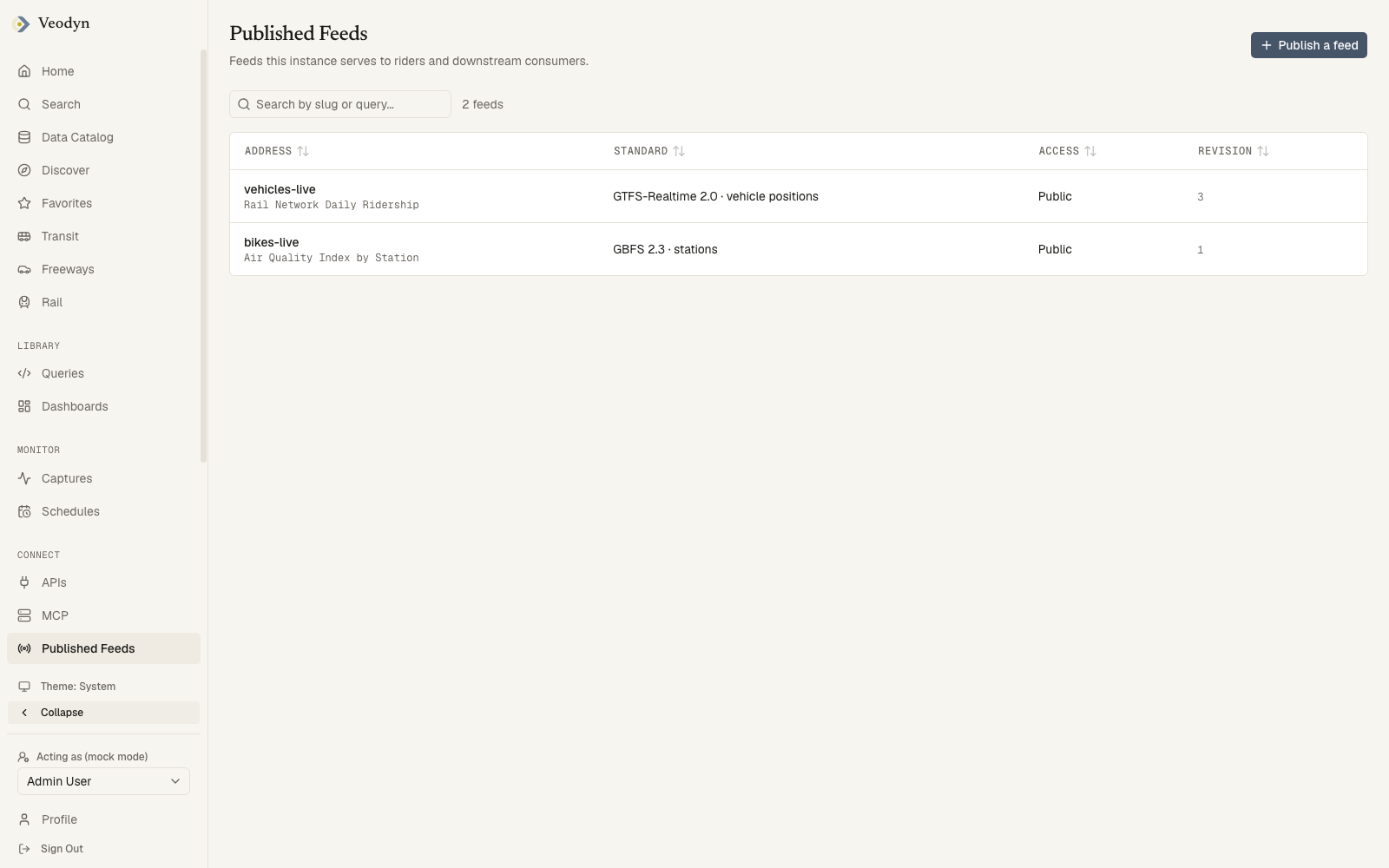
Four columns, and clicking a row opens that feed's page.
| Column | Holds |
|---|---|
| Address | The feed's slug, with the name of the query behind it underneath |
| Standard | GTFS-Realtime 2.0 · vehicle positions, or GBFS 2.3 · stations |
| Access | Public or Private |
| Revision | Which revision of the binding is current |
The Address column carries the source query's name as well as the slug, the same way Captures prints a capture over the connection it reads, so both what the feed is called and where its data comes from are readable without a click.
Search matches the slug, the query name and the visibility.
An empty list and a search that found nothing say different things (No feeds are published yet against No published feed matches that search), the same distinction the catalog draws.
Declaring a feed
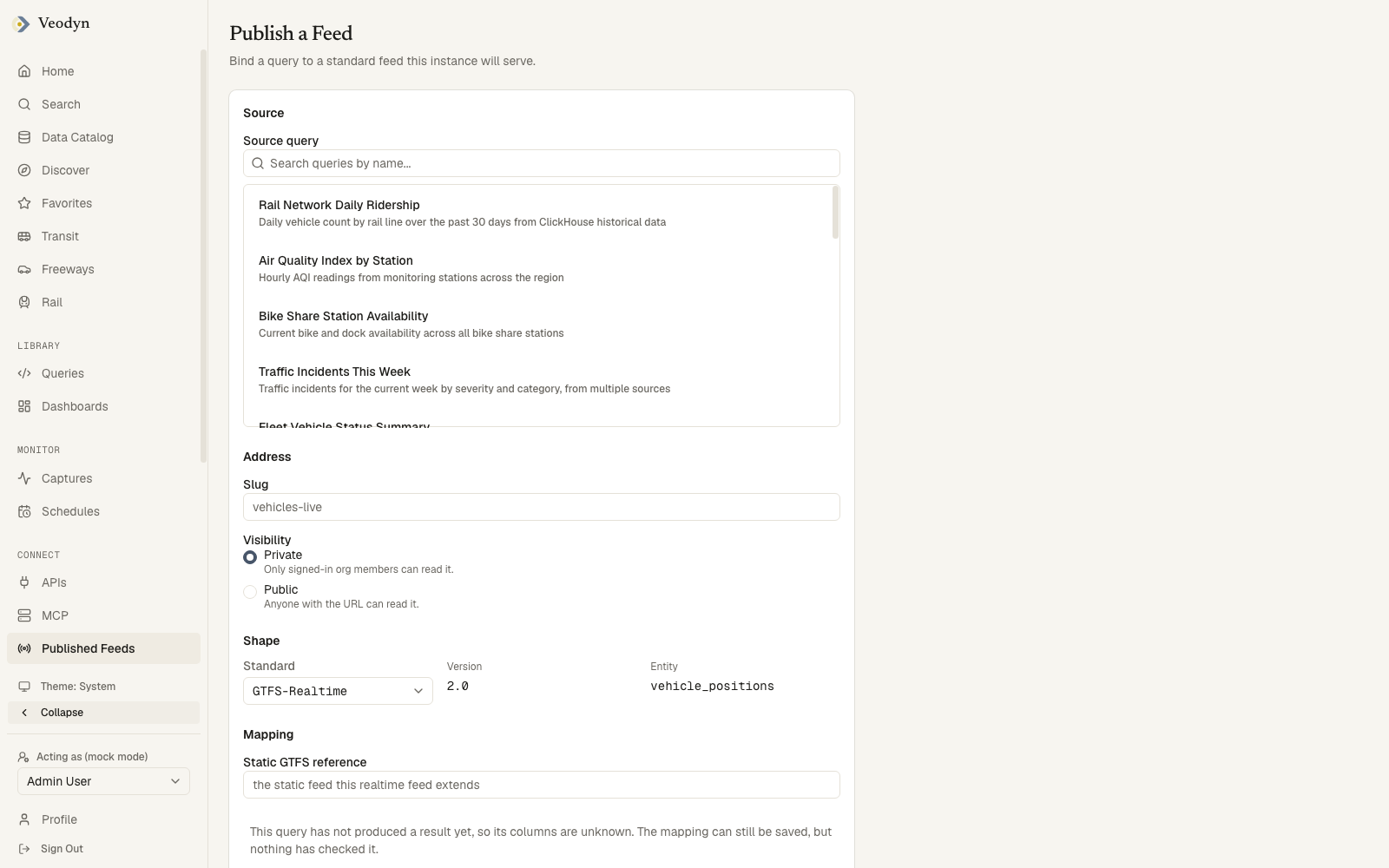
Publish a feed opens a form in five parts. Wherever a closed set of values exists, the form offers exactly that set, so there is little here that the API can refuse later.
Source
Pick the saved query whose latest results become the feed. The picker searches every query you can open.
Switching to a different query clears the column mapping. A field mapped against one query's columns means nothing against another's, and carrying it over is how a form quietly submits a mapping full of columns that no longer exist. Re-picking the same query after pressing Change keeps the mapping, so opening the picker and closing it again costs you nothing.
Normalizing before you publish
An ingested feed is not always publishable. Values that a source system writes without complaint can still be outside what the standard allows, and a publish attempt refuses them rather than passing them on: a station whose last_reported sits below the earliest timestamp GBFS accepts blocks the whole attempt, and the reason names the row.
The fix is a query rather than a setting. Add a data source of type results, which runs SQL over the cached results of other queries, point it at the connector read you already have, and bind the feed to that instead:
SELECT station_id, name, lat, lon, num_bikes_available, last_reported
FROM cached_query_7
WHERE last_reported >= 1450155600
The same seam handles the rest of it: dropping stations that are out of service, joining a name table the upstream feed omits, converting a unit, or combining two systems into one published feed. Whatever the query returns is what the mapping reads.
Address
The slug is the feed's address, so it reads as vehicles-live rather than as a number. It takes lowercase letters, digits and hyphens, has to start with a letter or a digit, and runs to 64 characters.
One name is refused outright: capabilities is a real endpoint on the same collection, so a feed slugged that way would sit at an address the API already answers on.
Visibility is two options:
| Who can read it | |
|---|---|
| Private | Only a consumer holding a token issued for this feed |
| Public | Anyone with the URL, no credential needed |
Signed-in members of the org see the binding, its publish history and whether it is serving, which is not the same as reading the feed. The bytes only ever come out of the address below, and for a private feed that address answers a token and nothing else. Issuing tokens is an enterprise feature, so on a community build a private feed serves nobody.
A public slug is claimed across the whole instance rather than within your org, because a public feed's address has no org segment in it. Taking one another tenant already holds is refused with a 409, and the refusal does not say who holds it, since that would turn the message into a cross-tenant directory. You can pick another slug, or keep the feed private.
Shape
Standard is a choice of two, gtfs-rt and gbfs, and version follows from it. GTFS-Realtime has one version, 2.0, and it appears as a plain fact instead of a dropdown with one entry, since a control with a single choice invites a click to find out what else is in there. GBFS has two, 2.3 and 3.0, so it gets a picker.
Entity is a fact or a picker, depending on what this deployment registered. A community build registers one entity under GTFS-Realtime, vehicle_positions, and shows it as a fact; under GBFS it registers two shapes, stations for a docked system and vehicles for a free-floating one, so that gets a picker. An enterprise build whose pack registers more widens the list. The form asks the running service what it holds instead of inferring it from a values file, and if that lookup is slow or fails it falls back to the single fact rather than showing an empty picker.
Mapping
The column map puts each field the chosen standard needs against a column of the query's own result.
Missing required fields are named when you submit, and the list updates as you map them instead of freezing on whatever was missing the first time.
A query that has never run has no columns to offer. The table says so, instead of showing a column of dropdowns whose only selectable value is Not mapped. You can still save a mapping in that state, and the page says that nothing has checked it.
GTFS-Realtime
A static GTFS reference, meaning the scheduled feed this realtime feed extends, is required.
| Field | Required |
|---|---|
vehicle_id, latitude, longitude | Yes |
trip_id, route_id, bearing, speed, timestamp | No |
GBFS
The shape picked above decides the vocabulary. For stations:
| Field | Required |
|---|---|
station_id, name, lat, lon | Yes |
num_vehicles_available, is_installed, is_renting, is_returning, last_reported | Yes |
num_docks_available, capacity, address | No |
The mapped fields are split into station_information and station_status automatically, so you map them once as one list.
For vehicles:
| Field | Required |
|---|---|
vehicle_id, lat, lon | Yes |
is_reserved, is_disabled, last_reported | Yes |
current_range_meters | No |
A vehicles feed publishes the discovery document, system_information.json and the version's own status file: free_bike_status.json on 2.3, vehicle_status.json on 3.0. No station file is written for it, and no vehicle_types.json either, so vehicle_type_id is not a field you can map yet.
System
A GBFS system also declares facts no query returns: a system id, a language, a display name and a timezone, and on 3.0 opening hours and a contact email. These are typed into the form and published as system_information.json.
On failure
There are two modes, and at serving time their names work out the opposite way round:
- Block refuses to publish a bad read. The feed keeps serving the last artifact that passed, with its original timestamp, for as long as that takes. Age alone never stops it.
- Last known good does the same, plus a required maximum age. Once the artifact is older than that, the address stops answering.
Last known good is therefore the mode that can take a feed dark, since choosing it means also stating how stale is too stale. The age field only appears in that mode, since the API refuses a cap on block and requires one on last_good.
What is checked when you save
The binding is validated before anything is written, so a refused save leaves the stored binding and whatever is currently being served untouched. The query has to exist and be readable, and the column map has to name columns its results actually have. A map that cannot produce the feed comes back with every problem named at once.
A GBFS feed is validated as a whole system against the version's JSON Schemas before anything is served; a finding blocks the publish, and GBFS findings are always blocking, so a GBFS feed publishes clean or not at all.
The feed's page
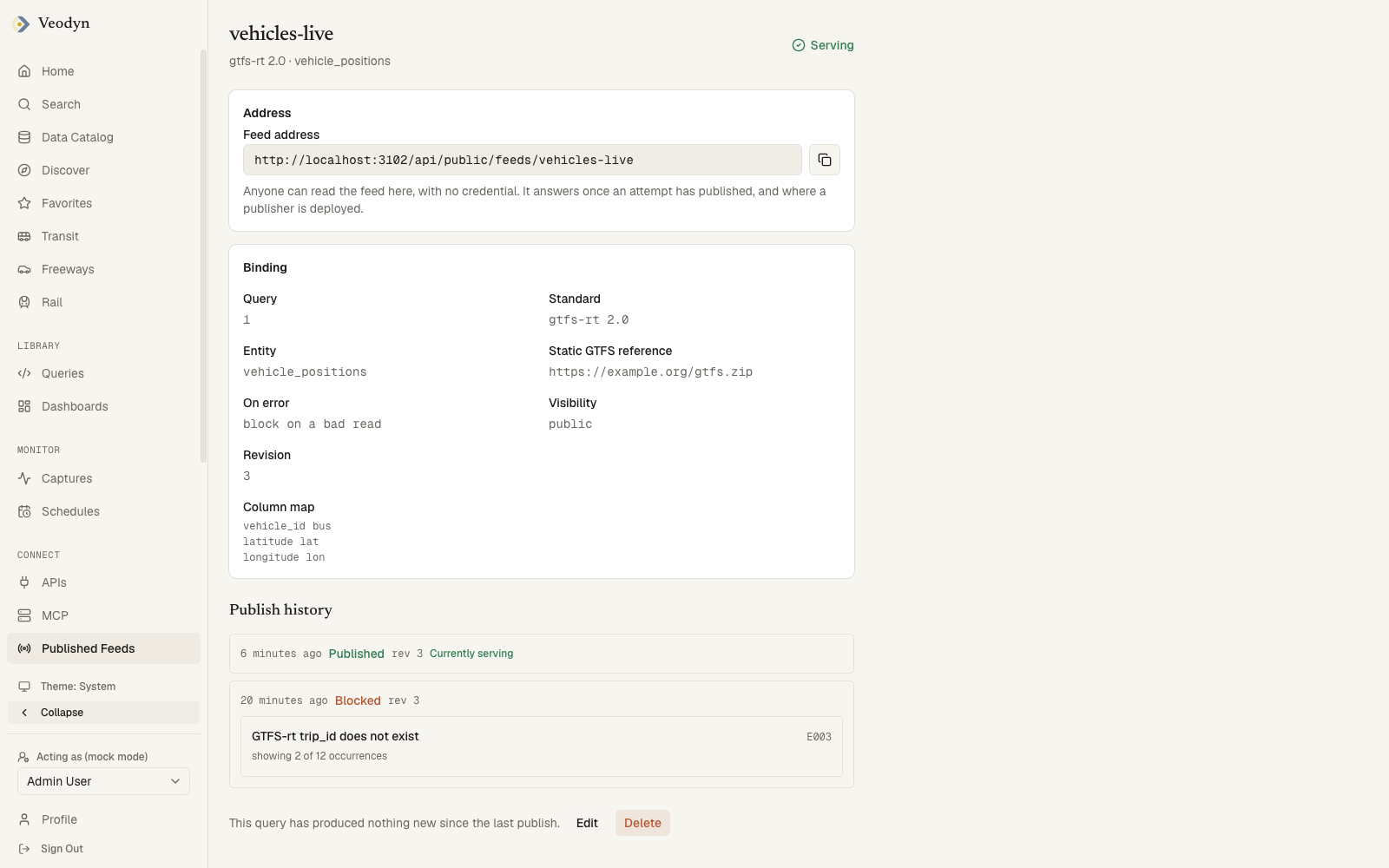
/connect/feeds/<slug> holds the whole record: what the feed is bound to, where it can be read, and every attempt to publish it.
Serving status
The header carries one word for whether anything is being served right now.
| Status | Means |
|---|---|
| Serving | An attempt published, and its bytes are what the address answers with |
| Not serving | The newest attempt published, but an edit or a delete has since retired the declaration it answered for |
| Blocked | The validator refused the bytes |
| Failed | The attempt never reached a verdict |
| Never published | No attempt has been recorded |
Not serving does not mean the attempt failed. It produced bytes, they passed, and they were served, and then something retired the binding underneath them. Labelling it Failed would put one decision on screen as another, three lines above a history that says Published about the same row.
These statuses describe serving state rather than mapping state. The page will not tell you the binding is valid on a read, because the check that would establish that only runs on a write.
Address
A public feed shows its full address with a copy button, and says that anyone can read it without a credential once an attempt has published.
A GBFS feed's address answers with the discovery document (gbfs.json); the member files it names sit underneath it, at /api/public/feeds/<slug>/station_status.json and its siblings, or the free-floating equivalents for a vehicles feed.
A private feed shows no address at all, and says why: reaching one takes an issued token, and issuing tokens ships with the enterprise pack. Printing a URL that turns every anonymous reader away would only send readers hunting for a credential this build cannot mint.
The page reserves a slot beneath that sentence for a token panel. A community build has nothing to put in it and renders nothing, the same as any other unfilled slot. An enterprise build fills it with the panel that issues a feed's tokens.
Binding
The committed declaration read back: query, standard, version, entity, static GTFS reference, on-error mode with its cap, visibility, revision, and the full column map.
Publish history
Every attempt the instance has recorded, newest first, with its decision, the binding revision it ran against, and a marker on whichever one is currently serving.
What appears under an attempt depends on the kind of answer it was:
- A blocked attempt lists the validator's findings, grouped by rule. The attempt's own reason is only a count ("2 conformance error(s)"), so the findings are the real explanation.
- A failed attempt has no findings, because nothing reached a verdict, so its one reason sentence is all there is.
- A published attempt lists findings too, where it has any, under Warnings the feed published with. Dropping the warnings at the point of success is how a slow drift out of conformance stays invisible until it turns into an error.
Findings group by rule, with the individual locators behind a disclosure, since one broken rule arriving as forty rows reads like forty problems.
The validator caps how many occurrences it exports per rule while reporting the true total separately, and where the two differ the disclosure says so. Printing the number of rows on screen as if it were the total would tell you two vehicles are broken when twelve are.
Publish now
An administrator can run a single attempt on demand.
The button is withheld in any state where an attempt could not succeed, and a sentence says which state that is:
| What is true | What the page says instead |
|---|---|
| The check is still running | Checking whether this query has a result newer than the one being served. |
| The query could not be read | This query could not be read, so there is no telling whether publishing would serve anything new. |
| The query has no cached result | This query has no cached result, so there is nothing to publish. |
| Its newest result is no newer than the serving one | This query has produced nothing new since the last publish. |
Each state gets its own sentence, because the page has established something different in each one.
Editing takes the feed off the air
Saving an edit to a feed that is currently serving takes it dark until a new attempt succeeds, and the interface will not let that happen quietly:
- The submit button reads Save and republish, but only when the feed is actually live. On one that is already dark there is nothing to republish.
- A confirmation states the consequence: consumers of the address get nothing in the meantime.
- Confirming fires the update and then a publish attempt right away, instead of leaving the feed dark until some later cycle.
A refused save keeps every value on screen, so a rejection does not cost you the mapping you just built.
A slug cannot be renamed, since it is half the feed's identity. Publish a new feed to change it.
Deleting
Delete asks for confirmation and says what it means: consumers of that address start getting nothing, a deleted slug looks the same as one that never existed, and there is no undo.
How a consumer reads a feed
GET /api/public/feeds/<slug> returns raw GTFS-Realtime bytes as application/x-protobuf. For a public feed it is the only route in the sidecar's community surface that takes no credential at all, on the grounds that most software speaking this format will never hold one.
In curl, against the instance's own origin:
curl -s https://transit.example.org/api/public/feeds/vehicles-live -o vehicles.pb
protoc --decode_raw < vehicles.pb   # or any GTFS-Realtime decoder
A GBFS feed answers with its discovery document instead, and the member files it names are plain JSON on the same path:
curl -s https://transit.example.org/api/public/feeds/bikes
curl -s https://transit.example.org/api/public/feeds/bikes/station_status.json
Three answers cover the whole surface:
| Status | When |
|---|---|
| 200 | The current artifact, in the binding's format |
| 404 | Every refusal, with one body |
503, with Retry-After | Under last known good only, once the artifact is past its age cap |
Everything it refuses answers the same 404, with the same body. An unknown slug, a slug naming a private feed the caller cannot open, and a slug that has never published a clean attempt are indistinguishable from outside. Telling them apart would rebuild the probing oracle that a single 404 exists to close, letting a caller work out which slugs are taken, or merely dark, one guess at a time.
Staleness is the one exception, and only under last known good. Once the artifact is older than the configured cap, the endpoint answers 503 with a Retry-After carrying that cap instead of serving stale bytes.
Two details matter if you are consuming one:
Retry-Afteris the feed's own age cap rather than a prediction, since the endpoint cannot know when the next publish will land. The cap is the only interval anyone has stated about this feed's tolerable staleness.- Age is measured from the artifact's own header timestamp, not from when the attempt was recorded. The header is what the served bytes tell a consumer the data's time is, and measuring the pipeline instead would call a fresh publish of hours-old rows current.
Under block there is no staleness branch at all. Block governs whether a bad read gets published, and the engine settled that before those bytes ever became current.
Reading a private feed
A private feed is read at that same address, with a token its owner issued. Two transports, accepted equally:
GET /api/public/feeds/<slug>?token=<token>. This is the one to try first, since plenty of feed pollers are a URL field and nothing else, with nowhere to put a header. A token in a URL can be recorded by proxies along the way, which is what rotation is for; this service redacts it from its own access log.Authorization: Bearer <token>on the same request. Only that scheme is read as a token.
curl -s "https://transit.example.org/api/public/feeds/partner-feed?token=<token>"
curl -s -H "Authorization: Bearer <token>" https://transit.example.org/api/public/feeds/partner-feed
Presenting the same token both ways serves normally. Presenting two different ones is refused instead of arbitrated, because picking a winner would leave a consumer reading on through a token they believed they had revoked. A public feed serves whether or not a token comes with it, so a client that attaches one everywhere is never turned away for it.
A GBFS discovery document carries no token. The member-file URLs inside it are the plain addresses, and the consumer appends its own token to each of those requests exactly as it did to the discovery request.
A wrong token, a revoked one and an expired one all answer the 404 an unknown slug gets, so the reply tells the holder of a dead token nothing about whether the feed is still there. The stale 503 is only ever reached after a token has resolved, which keeps it from disclosing a feed to a caller the feed is closed to.
Issuing these tokens is an enterprise feature. A community build registers nothing that resolves a token, so a private feed there serves nobody and a presented token changes nothing.
What community ships, and what it does not
The validator
Conformance rules are not written here. They come from gtfs-rt-validator, the project's own Python package, and validator/ in the repository is a small HTTP wrapper around it that the sidecar calls over the network.
It runs as its own service because the validator loads the agency's static GTFS archive to check against, which costs roughly 48 seconds and holds about 584 MB per feed. In-process, every API replica would carry its own copy and pay that on a cold call. One service holding one prepared archive answers in about half a second, which is what makes validation possible inside a publish request.
VEODYN_FEED_VALIDATOR_URL names the service. Leave it unset and every publish attempt fails closed, recorded as a failed attempt.
Failing closed is what the service is meant to do here, rather than a misconfiguration to work around: an empty finding list from a validator that never answered looks exactly like a clean feed. See Configuration.
| Community | Enterprise | |
|---|---|---|
| Declaring, editing and deleting a feed | ● | ● |
| Publishing on demand, and the attempt history | ● | ● |
| Serving a public feed anonymously | ● | ● |
| Issuing a token, and serving a private feed to whoever holds one | ● | |
vehicle_positions | ● | ● |
| Further entity types (trip updates, service alerts) | ● | |
| A worker that publishes on a schedule | ● |
So a community build publishes when an administrator presses the button, and an enterprise one also publishes on a cadence of its own.
Publishing on a cadence
An enterprise deployment runs a worker beside the API, and a feed's page carries an Automatic publishing panel. An administrator picks how often the feed republishes: every minute, every five, every fifteen, hourly, or daily. A minute is the floor, because that is how often the worker looks.
Each pass reads the bound query's newest cached result. When the query has produced nothing since the last publish, the pass records no attempt: the publish history stays a record of what was served, rather than a line per tick. A pass that fails backs the feed off, doubling from two minutes up to an hour, and the panel says how many failures have run together.
Turning it off leaves the feed as it is, still serving its last published artifact and still publishable by hand.
Downgrades fail closed rather than reinterpreting anything. A feed bound to an entity the current build no longer registers goes on showing the entity it was bound to, not a value invented from today's registry.
Why a mapping fault is never reported as a data fault
Serialization always runs before validation. Hand the validator bytes built from a column mapped to the wrong thing and it answers with whatever conformance rule that happens to trip: a trip id that does not exist, a position outside the agency's bounding box. The operator then goes looking in the schedule for a fault that lives in the binding.
Building the bytes first means a mapping defect gets named as one, and a verdict only ever describes bytes that exist.
Only a clean verdict moves the pointer, and on any other decision the address carries on serving the last artifact that passed.